Saturday, July 18, 2020

Leavenworth, Topeka and Southwestern Railroad (Part 1)


Originally written by John Bower, as a two-part article on the L.T. & SW Railroad, this article was published in the Jefferson County Historical Society Newsletters of August and September 1982.
- - - - - - -
It is not my purpose to write a complete history of the Leavenworth, Topeka and Southwestern Railway (in my time [Mr. Bower’s time] it was called the Leavenworth and Topeka, the L&T, the Southwestern or “Old Jerky”). This is the story from a Jefferson County perspective its construction, its struggle to survive, and its part in opening up a rich rural region.

Principal source for the early history is The Oskaloosa Independent, published for 100 years in Oskaloosa by the Roberts family (to be cited as IND, or simply by the date of issue where the source is indicated by the text). [John Wesley Roberts was the Independent editor at the time of the L.T. & SW Railroad bond issues and construction. His son F.H. Roberts took over as editor in July 1882.]


Jefferson County had railroad fever in 1881. Nine years after the Kansas Central built through Winchester and Valley Falls, Oskaloosa was still without a railroad. Dependence on horse transportation meant isolation and business stagnation.

“Two railroad companies are preparing to build roads to this place as soon as wind and weather permit...(IND 1/8/1881) “Parties in the interest of the Kansas City, Oskaloosa and Northern Railroad were here yesterday, and left for Valley Falls in the evening... our Topeka and Leavenworth neighbors will have to hurry up or they will get left.”

With federal grants for railroad building no longer available in the 1870s and ’80s, promoters turned to local areas for funds to build the roads to serve them. The key to getting a railroad was the approval of bonds by the cities and townships benefitted.

Petitions for bonds for the Leavenworth, Topeka and Southwestern were being circulated in Jefferson County in January 1881 (IND 1/22/1881). Election notices appeared February 12; Oskaloosa Township proposed $29,000. Osawkee Township $25,000, and Rock Creek Township $16,000. These were 30 year bonds, bearing six per cent interest. They were to be exchanged dollar for dollar for stock in the railroad. Each proposition gave an approximate location for a depot within the township. The line must be operating within the township within one year to qualify.

The Independent had opposed Jefferson County bonds for the Kansas Central (6/16/1871). But Roberts threw his full support behind the proposal to build a railroad from Leavenworth through Oskaloosa to Topeka and beyond. Announcing a meeting for the purpose of “consulting in reference to the best railroad interests of the county at this time,” the Independent urged, “Go to the railroad meeting at the court house this Saturday.” (1/22/1881)

“As a mere matter of speculation,” said the Independent on March 5, “it will be paying investment to the townships, and will render a rich return for the outlay... If the citizens of Rock Creek and Osawkee Townships fail to carry the propositions submitted to them to vote aid in the cost of the proposed railroad through their territory, they will throw away the only probable opportunity they will ever have to advance their interests in this direction.”

Editorials on March 5 and 19 laid out the main arguments. To objections of some that they didn’t like the method of financing, or didn’t want it on their farm, Roberts argued that it would enhance the value of real estate, bringing in new people and businesses. He saw cheaper prices at the stores, higher prices for farm produce, good wages, more demand for labor.

Since the new railroad would pay taxes, it would pay a considerable part of the debt incurred in its favor. Roberts calculated potential tax benefits at Oskaloosa to show the bonds were a bargain. This benefit would continue after the bonds were paid off. If the line made money, townships would profit from the stock they held.

Roberts did not stop with logical arguments. “The probabilities are that this is the last call, the acceptable time, the day of salvation,” he intoned with Old Testament fervor. “Then do not remain straddle of the fence longer... but act promptly, do your duty by voting for the railroad and look forward for and expect a better day.

“Next Monday is the day set for voting aid to the railroad in this township.” (IND Mar. 19) “We learn there are some citizens so far behind the times they propose to vote against it. They are to be pitied for their lack of enterprise and sagacity. Deal with them gently. If they never grow wiser they will die so far behind the times it will take them a hundred years on the other side to see the first glimmer of progressive daylight.”


Oskaloosa approved the bonds 335 to 18 (Mar. 26). Rock Creek Township carried by 104. Osawkee by 113. “Hurrah for the railroad!” said the Independent.

Petition for a vote on $15,000 in bonds in Union Township, signed by O. Hosford, J.F. Willits and 83 others, was reported March 5. The election would be Tuesday, April 19.

With the vote approaching, the Independent observed (Apr. 9), “we take it the people of Union Township are too intelligent and progressive to require any words from us to vote for the bonds.”

When the election carried by only 16 votes, Roberts commented (Apr. 23), “There are more men behind the times in Union than there ought to be...” One can surmise the proposal to locate the railroad depot more than two miles from Dimon, largest settlement in the township, [actually on the Leavenworth County border] may have had some influence on the vote.

The same issue reported that Topeka had approved bonds for the railroad by over 500 votes. Bonds for a railroad, apparently the L.T. &. SW, passed in three of four townships in Morris County. Alexandria Township in Leavenworth County was to take a vote. Leavenworth voted $50,000 for the railroad by a margin of 796 votes. (Aug. 20)

Surveyors were reported “between here and Topeka” on May 14. A May 28 editorial belittled the ignorance of The Kansas City Journal for saying the new railroad would have no local traffic, asserting that is on the same level as the fear of being scalped by Indians in Kansas City.

Engineers were reported locating the actual line of the road on August 6. They were expected to reach the west line of Leavenworth County “this week.” (Aug. 20)

Signing of the construction contract was reported August 27. This conflicts with a 1925 report of the Interstate Commerce Commission, which says the contract was let September 3. (Docket 601, Interstate commerce Commission, Sept. 24, 1925)

September 3 the Independent was reassuring people of Osawkee and Rock Creek that nobody at Oskaloosa was trying to change the route of the railroad. The following week arrangements were reported complete for building the entire line from Leavenworth “into Lincoln County.”

Iron for 240 miles was said to have been purchased, and the contractors expected to have the first 40 miles completed by November. (Sept. 17) Some people around Thompsonville wanted part of the new road, and there was talk of dividing Kentucky Township.

The proposed route across the middle of Leavenworth and Jefferson Counties was not an easy place to build a railroad. When the farthest reach of Kansan glacier dumped its accumulated load, it left a high prairie whose highest point at McLouth is nearly 400 feet above the Kansas and Missouri rivers which skirt it on the south and east. This prairie is deeply etched by streams flowing to the Kansas River, forming a series of valleys and highlands across the path of the new railroad.

In 46.5 miles from Leavenworth to Meriden, the line crossed four major streams and many lesser ones. Construction required a rather heavy 33,000 cubic yards of excavation per mile. There were four iron bridges from 57 to 120 feet long, and 49 pile and frame trestles. Construction cost was more than $20,000 per mile. (Docket 601, ICC op. cit.)

Some older towns suffered from their high location. The line entered Jefferson County following the divide between Fall and Tonganoxie Creeks, more than a mile north of the pioneer village of Dimon. Residents there blamed Amos McLouth, probably not without reason, for diverting the railroad to cross McLouth’s farm, where he promptly started a new town. But the valley of Tonganoxie Creek would have been a serious obstacle to reaching Dimon from the northeast.

Continuing toward Oskaloosa, the line crossed present K-16 highway a mile west of McLouth and followed the divide between Buck and Slough creeks. This ridge led into Oskaloosa from the southeast, but beyond was Slough Creek, 150 feet lower than the courthouse and little more than a mile away. Engineers made the descent by bypassing Oskaloosa on the south and west, going down the draw where the city lakes now are [in 1982].

Oskaloosa depot was in the valley west of town, inside the sharp curve where K-92 highway turns northwest to follow the old railroad line. The steep, rocky road running up the hill northeast from that spot was for more than 40 years the road from Oskaloosa to the depot. The Independent bitterly protested this location of the depot. Farmers complained it was the most inaccessible spot around Oskaloosa, requiring useless travel over a bad road, and threatened to go to Winchester or Perry instead. They blamed Oskaloosa citizens for not making more protest against it. (Nov. 26)

It was reported the man who made the first survey was in the employ of the Santa Fe, and deliberately “ran a most ridiculously crooked route, apparently for the purpose of showing that a straight line could not be secured... Why the line should be run over the highest ground in this region when a route 50 to 60 feet lower can be found and requiring nearly a mile less to make the ascent or descent is a conundrum which people of common sense cannot answer.” (Dec. 10)

The route selected required a cut 1,000 feet long and 30 feet deep east of present U.S. 59 highway south of Oskaloosa (the Independent dubbed it “the engineer’s folly”), while the depot was located “out-of-sight of the world where it would be the least possible value to the city and the township.”

Roberts favored a route down “Newell Creek” on the east side of town, with the depot perhaps near the present site of the county shops. “It is all non-sense,” he said, “to talk of this place being inaccessible.”

December 17: “We say once more to the managers of the railroad that they are standing in their own light and working against their own interests in not seeking a more satisfactory location of the road and depot at this place... If the company should faithfully try to secure a route for their road through the corporate limit of the town and fail, the citizens will pay the expense of the survey.”

But, when the engineers stuck to their decision, leaving Oskaloosa one of the few Kansas county seats without a railroad through town, the Independent never wavered in its support. December 31, 1881: “Col. Snow informs us that they have commenced laying track on the railroad at Leavenworth, and have two engines there for service. They will have the cars running to Oskaloosa by the first of March. Whoop it up, Colonel.”

January 7, 1882: the Independent featured a long letter, signed by “I” (probably John N. Insley, civil war veteran and leading citizen of Oskaloosa, according to Bill Leech), counseling the community to stop quarreling with the location of the railroad depot and build a first class road from the square down to it. A survey for such a road was reported February 18, and again June 24. Why they waited 40 years to build it is not clear.

February 4, 1882: Mr. McLouth has laid out a townsite of 135 lots where the Leavenworth, Topeka and Southwestern Railway crosses the county road on the west line of his farm, and will have George Davis sell the lots at auction this Saturday.”

February 11: “Track is being laid on the L.T. and SW Railroad at the rate of a mile and a half a day. The county line will be reached before the first of March, we are told. Completion of the line into the county was reported March 4.

March 25: The cars will be running to McLouth in a few days. “This is the first use we have seen of the name ‘McLouth’ to designate the new town.”

Many of the workers were reported leaving the railroad construction crews because of the shameful manner in which they were paid. (Apr. 8) Roberts thought contractors who cheated their men ought to be in the penitentiary, “along with other thieves.”

Two adjacent sections of road-bed east of McLouth were said to have been laid out with jump-off of three feet in elevation, requiring regrading before track could be laid. “No wonder such scientific and skilled engineers could not find a route through this city!” Roberts snorted. (Apr. 22)

Meanwhile, work was progressing west of Oskaloosa, between Slough Creek and Osawkee, the most rugged part of the route. Slough Creek Times, March 11, reported, “There is one cut one fourth mile in length and ranging from six to 21 feet deep. Half the depth is hard limestone rock, which has to be blasted out with powder. West of this cut is a small mountain sloping up from Little Slough Creek to a height of 300 feet. The road passes halfway down the slope. There are two fills ranging from 30 to 34 feet in depth and 300 feet long... ”

“One of the Rice Brothers” was preparing to make a blast in this cut when blasting caps exploded in his pocket, injuring him severely. He was recovering at St. John’s hotel. Rice Brothers had a construction contract on the railroad. (Aug. 5)

Freight was coming to Oskaloosa by the new railroad line by May 6. “Our people all go (to Leavenworth) by the new railroad now. “A hack from Lohman and Sprague’s met the train at the end of track three miles east of town.”

Roberts took his first ride on the new railroad the week of May 20, and was surprised how smooth it was. He said the new depot building at McLouth “is in good style and taste, and creditable to the railroad where it is located.” The river bridge at Osawkee was finished. The first “excursion” on the new line was reported, and the first timetable appeared in the paper. Fare to Leavenworth was $1.15; from McLouth, $1.00.
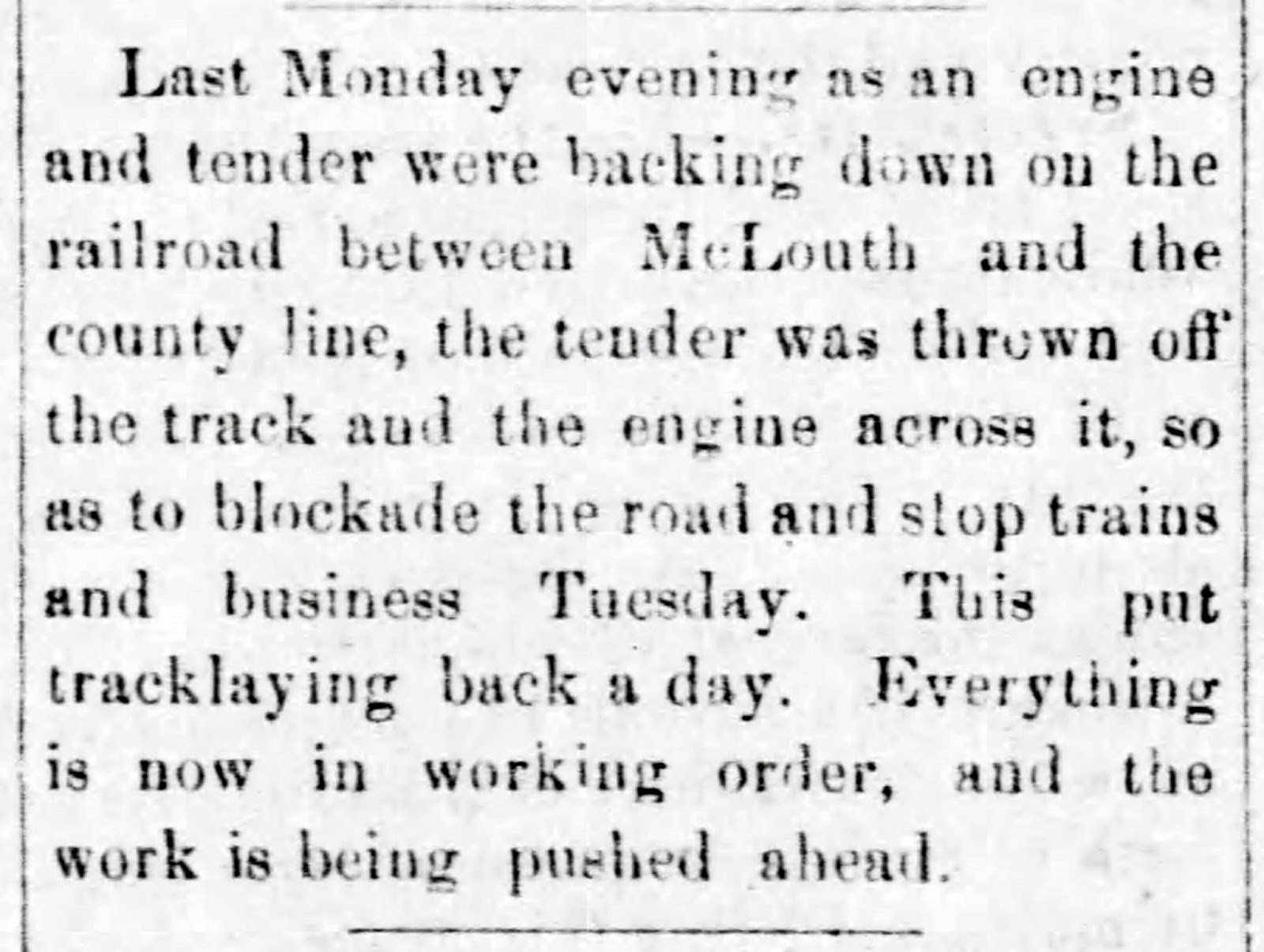
 
The Oskaloosa Independent, June 3, 1882
The first train wreck was reported June 3. An engine and tender jumped the track east of McLouth, blocking the line for a day.

There was a big celebration in Oskaloosa June 2. (June 10) Between 500 and 600 people came from Leavenworth. Farmers and townspeople helped bring people from the end of track south of town. The Barry Cadets drill team “drilled in a masterly manner.” Oskaloosa Glee Club sang and the band played. About 2,500 people were there from over the county. Completion of the line through Oskaloosa Township was reported June 24. Mail was going to Leavenworth by train, with much better service. (July 8) There was a new post office at McLouth, and the Independent had a growing club of subscribers there getting the paper by train.

Oskaloosa depot was built with a second story, with rooms upstairs for the agent’s family (July 22). E.T. Albert was the first agent. (Aug. 19)

Grading and bridges had been completed to Meriden by July 22, but work was still being done on “expensive trestlework this side of Osawkee.” One trestle was 700 feet long. Another, 400 feet long, was being filled-in with earth. (Aug. 26)

Apparently difficult areas were bridged by trestle, then filled in, with fill material probably hauled in railroad cars. One of these trestles was still in existence in 1981, hidden by brush and trees on a hillside above Little Slough Creek about four miles east of Osawkee, according to Roger Coleman, Jefferson County Soil Conservationist.

While they were building through this rough country time ran out on the bonds voted by Osawkee and Rock Creek Townships, and the original bonds and matching railroad stock were destroyed by the county commissioners. (July 15) A spirited campaign was waged at Osawkee to renew their $25,000 commitment, but it lost by a narrow vote. (Aug. 19)

The Independent deplored this unfairness to the railroad which had kept its promise to give them a road, but many people probably felt no need to pay for something they were going to get anyway. There was no mention of any second vote in Rock Creek Township. Delay had cost the promoters $41,000.

Announcement the following week that the L.T. & SW had been purchased by the Santa Fe railway brought a dramatic change in the situation. It was to be completed to Meriden and operated as other branches of the Santa Fe system. The Independent approved, for this guaranteed the line would be completed.

Shortly thereafter, the construction camp was moved to Meriden (Sept. 23). The line was to be finished from that end.

While grading had been largely completed to Topeka (traces of the old grade can still be seen along Meriden Road in Shawnee County), rails were never laid beyond Meriden. L.T. & SW trains went on into Topeka on the Santa Fe tracks. (ICC Docket 601, op cit.)

The first train from Leavenworth to Topeka via Oskaloosa a locomotive and one car — went through Tuesday, October 10. (Oct. 14) “There was not much noise about it,” the Independent said, “but it was an important event anyhow, marking the opening and completion of a line of road through the center of one of the oldest and last counties of this state, and giving the county seat direct connection with Topeka and Leavenworth something she has waited for lo! these many years.”

Another important event was recorded in the same issue; the telegraph line was completed as far as Oskaloosa. The first message was sent Wednesday afternoon. Now news of the outside world was only minutes away. The line was built through McLouth October 6. (Oct. 7)

The first section gang at Oskaloosa was established, with Thomas Coffey foreman. (Oct. 21) N. Glenn bought the first ticket from Oskaloosa to Meriden. (Meriden Items, Oct. 28). Construction of the new railroad opened up a rich agricultural area in Leavenworth and Jefferson Counties. It became one of the best “feeder” lines in the state (Topeka State Journal, Jan. 12, 1918), bringing livestock and farm produce to the then considerable food processing industry in Topeka.

Economic growth was stimulated. Oskaloosa had a sawmill (IND Aug. 19) and a new brick plant. (Aug. 12) Coal from Leavenworth was only $4.30 per ton by the carload. (Aug. 28) Oskaloosa schools would save $45 over previous year on the winter’s fuel supply.

“Since the beginning of the railroad agitation, the Independent reported July 22, “some 43 new business houses and residences have been built in Oskaloosa.” That is a remarkable growth for an already established small town.

New towns and shipping facilities were springing up. McLouth grew rapidly, establishing itself as an important trade center. Others, like McIntosh (two and one half miles southeast of Oskaloosa half a mile south of Robbins Auto Salvage), and Ackerland in Leavenworth County, disappeared with the railroad. A few houses still remain of Spring Valley, laid out near Oskaloosa depot in the fall of 1882 by N. Macomber. (Oct. 14)

Thus the hope of local citizens who bonded themselves to secure the benefits of railroad transportation, probably were realized. But the hope of promoters to reach far away places and reap big profits were not. The L.T. & SW did not make money.

Possibly foreseeing this, the Independent editorialized August 23, “It is a good deal better for Oskaloosa that the Santa Fe has the road than that an independent company should run it.” Topeka interest did not agree. They thought it would stifle competition. (Sept. 2)

It soon became known (Sept. 16) that the Union Pacific had become joint owner with the Santa Fe. They did not integrate the line into either of the parent roads, operating it as a subsidiary, with its own officers and headquarters in Topeka. For 35 years the parent lines absorbed its losses. (ICC Docket 601, op. cit.)

Thus history would confirm both viewpoints, but that is another story.
 
John D. Bower
TO BE CONTINUED

This story appeared in “Yesteryears” in October 2014.

Saturday, July 4, 2020

Jefferson County's Pastime


Baseball, Oskaloosa vs. Ozawkie

From the Oskaloosa Times, June 13, 1902

Last Tuesday, before a good-sized crowd, the Oskaloosa first nine defeated the Ozawkie ball club by a score of 3 to 1. It was a great game, both sides playing fast ball and but few errors were made. The battery work of Conant and Davis for Oskaloosa was excellent and Root pitched a good game for Ozawkie. Conant struck out 12 men and Root 7. Oskaloosa scored 2 tallies in the 2nd inning and 1 in the 6th. Ozawkie’s tally was made in the 3rd inning, but according to the rules which were looked up afterwards this tally should not have counted. In the last half of the 9th inning it appeared as if Ozawkie would score several more runs, but effective work by Conant, Mains and Dick prevented it. Three men were on bases and only one out, a fly was knocked out into right field but it fell into Irl Mains mitt and stuck there. The next batter knocked a beauty out into left field and it dropped into Homer Dick’s basket and nestled there. The Ozawkie nine was strengthened by Geo. Chapman, former shortstop for the Oskaloosa club, while the home team had Ernest Thompson, a new player on 1st, and he did good work. This game demonstrates the fact that Oskaloosa has a first-class ball team, and they deserve encouragement and better support than they have been receiving.

This story appeared in “Yesteryears” in October 1988.

Saturday, June 27, 2020

For a Yearling, McLouth Takes the Cake.

From the Valley Falls Register, May 30, 1884

The fact has become more or less general that Kansas, especially the eastern part of the state had got over mushroom growth, a growing up in the night, as it were. But here we find in McLouth a fine well-built and enterprising little city of five hundred souls with its hotel, business blocks, elevators, etc., that but one year ago contained less than twenty-five inhabitants. Such is life and such are Kansas business men; this thing will never cease until Kansas becomes one of the greatest and most powerful states in the union.

The Register is booming and it heard McLouth was having a boom of its own so the Register man who takes delight in being around where the booming business is going on, concluded that McLouth was a pretty good place to strike, so he went down there last week and took a hand in the game.

There are no churches or schools there at present but a good graded school building will soon be built and two churches are, or are about to be contracted for and during the year places of worship will be completed.

The McLouth house M. McMaster proprietor is a new house pleasantly situated with the best sample room in the county, the tables are supplied with the best and Mr. McMaster will be found to be an agreeable and accommodating landlord.

The large and extensive farm implement house of Messrs Scott and Cresse is the principal trade feature of the town. These gentlemen deal largely in their line of goods and are known to be men of integrity and of first class business qualifications.

G.M. Woodhull [Woodhead] deals in furniture trunks pictures, he also is prepared to do undertaking. The people in this part of the county will find Mr. W. a fair square dealer and all goods in his line to be as represented; go and see him.

Delaware Grange cooperative store carries a fine line of general merchandise, their stock is new and clean and operated by gentlemen of experience and ability. This system of merchandising is doing a very successful business at this point.

Mr. A. Burt the popular and agreeable druggist located near the depot is having a nice run of trade. He carries a large stock of all the best medicines, drugs and toilet goods to be found in the town.

C. Moser carriage, blacksmithing. This gentleman is turning out some fine work. Mr. M. is a first-class workman, and the public may rely on his work both in style and finish.

—On The Wing

This story appeared in “Yesteryears” in October 2007.

McLouth was founded in the 1880s. It was named for Amos McLouth, the original owner of the town site. The first post office in McLouth was established in May 1882.
We had a railroad that ran right through the middle of town. The tracks are the dividing point for the north side and south side of town. Look for the Historical sign showing where the split is at."

Saturday, June 20, 2020

History of Boyle, Kansas


From The Winchester Star, October 9, 1942 (copied by Raymond Riley)

Boyle, Kansas, is located 25 miles west of Leavenworth, the highest point between Leavenworth and Valley Falls. The first post office was located one fourth mile east of the present office; and Mrs. Nancy Kendall was the post-mistress. The office was in the Kendall home, a log cabin, which stood for many years after the post office was established in the early 1860s.

On June 4, 1872, the first train arrived in Boyle with the first mail pouch containing letters and the Leavenworth Times, The Toledo Blade and an Atchison paper. By this time the post office had been moved to Mr. Jack Bates’ store, which had just started. Boyle now had its narrow gauge railroad, running thru a fine farming country in the northwest and east and timber and coal in the hills to the south; and its future looked very bright. Business was good, as lots of corn was shipped out and more hay was shipped out of Boyle than any point between Valley Falls and Leavenworth. Coal was shipped in and sold for ten cents per bushel or ten dollars and fifty cents per ton, on the track. The load limit of a coal car was 16,000 lbs. or 8 tons.


On August 14, 1875, the grasshoppers came. The sky was clouded with them and they left little behind them when they left. There was not much to ship out that year, but a daily train carried the mail, news and friendly good cheer. The two conductors on the run were Al Stokes and Jim Hall, and they were Al and Jim to the Boyle folk. If any of the boys were in Winchester they just got on the train with no cash and were never thrown off, but if the train was not traveling too fast they hopped off in their own yard, otherwise the train stopped in Boyle.

The last day of March, 1876, a great snow fell, drifting and blocking the railroad for two weeks. The store got low on staple goods and so the farmers that could, took their shovels and helped the railroaders clear the track. Mr. Bates had been helping at this work and had shoveled snow all morning, and in the afternoon he dropped dead with a heart attack. Six men, George Griffin, John Sowers, and Bob Kirkpatrick being among them, walked to Valley Falls and carried a casket out on their shoulders. The next day it took four horses hitched to a sled and several men to lay him to rest in Spring Grove cemetery.

There were several changes after Mr. Bates’ death, with different persons operating the store and post office, among them being John Boyle Sr. and John Boyle Jr., W.T. McClure, Frank Carr, Sam Heney, Newton Henry, a Mr. McCreary, and now Mr. C.A. McNeal and wife, who have been there forty years, and can sell you anything from a paper of pins to a gang plow. So Boyle still has the post office, general store and a good Methodist Church where Sunday School and church services are held every week. I always had respect for the Lord’s day and a community of generous people, and always enjoyed being at my hometown and birthplace.

John J. Ingalls once said, “God could have made a prettier place and a better place to live in, but I am sure he never did.”

—W.S. Fulton in the Valley Falls Vindicator

This story appeared in "Yesteryears" in October 2014.

Thursday, June 11, 2020

Valley Falls Bank Robbery, 1890


The Valley Falls Register, Friday, March 7, 1890

From The Valley Falls New Era,
March 8, 1890
Just before six o’clock last Saturday afternoon John Coen, cashier in the bank of Hicks, Gephart & Co., pale and trembling rushed out of the front door of the bank and told passers by, as best he could, that the bank had been robbed of a large sum of money a few moments before. He first saw A. Harmon and L.M. Tutt. The startling news spread rapidly; guns and revolvers were in hand, and everybody soon on the lookout. But the fleeing robber escaped from sight by dodging three blocks east passing out at the stock yards. Darkness came on. Telegrams and telephone messages were sent in various directions giving notice of the robbery. Armed men were detailed to scour the country and board every out-going train. The hours wore on. Finally at midnight a dispatch from Meriden 15 miles distant, gave the information that a stranger, answering the description of the robber had stopped there and gone to bed in the hotel. He had told the night operator that he was a “slicker.” Suspicion was fastened upon the stranger. How to capture him was the question. The officials at Meriden asked for help from Valley Falls, and Joe Summerville and Hal Shire volunteered to do the work and left in a buggy at 1:30 p.m. They arrived at Meriden between four and five o’clock and consulting constable Garber and landlord Garber, of the American hotel, laid their plans to capture the bold bad man. And they planned wisely and safely. But would they get the right man! The robber had left word with the clerk to call him at 5 a.m. as he wished to go to Atchison on the morning train. He slept up stairs. At the appointed hour he was called by the clerk, arose promptly, dressed himself and walked down stairs into the office, where the brave deputies were stationed, armed with double barreled shot-guns, heavily loaded. The robber cheerily bade the clerk good morning closing the door behind him. At the same time he was ordered to throw up his hands and he saw, doubtless to his complete surprise, that he was covered by two sudden-death-dealing weapons. He haulted not nor held up his hands, coolly and silently walked toward the stove, crossing his arms and reaching to his side coat pockets for his pistols. Again he was ordered to throw up his hands and again he refused, hoping, perhaps, to un-nerve the deputies, or by a skillful maneuver draw his double action revolvers and stand an equal chance with his captors. To him it must have been an awful moment. To surrender would be to expose his guilt — not to do so he might escape. His time had come; the triggers were pulled, simultaneously, and the heavy report from two shot guns sounded the knell of his departure into eternity. The daring robber fell backwards, dead, his feet near the stove. He raised his head and shoulders slightly from the floor and sank back stilled in death. One full charge entered just above his heart and the other in part, his right shoulder. The body lay there until noon, when county attorney Gephart, and witnesses from here, arrived to attend a coroner’s inquest and examine the effects of the dead man. $2,812 was found on his person, all in his boots except $24, one package of $500 in bills, having the bank wrapper on it, endorsed 2-27-1890 – Coen; that is on Feb. 2nd [27th?] 1890, Coen counted that package. The other packages were recognized. The robber had $1,000 less than it was supposed he had, Coen in his excitement having over looked the package in the safe.

From The Valley Falls
New Era
, March 8, 1890
A coroner’s inquest was held before Justice Fraser, and the following verdict was rendered. State of Kansas, Jefferson county. An inquisition holden at Meriden in Jefferson county, on the body of an unknown person there lying dead, by the jurors whose names are hereunto subscribed. The said jurors upon their oath, do say that the dead man is to us identified as that of the robber of the Hicks, Gephart & Co. bank at Valley Falls, Kan., on March 1, and killed by a gunshot wound while attempting to escape arrest at Meriden, Kan., in apprehending him as said robber.
We find that said killing was lawful and justifiable in every respect.
We further find that said death was not felonious.
In testimony whereof the said jurors have hereunto set their hands, the day and year here below written. March 2, 1890. Abraham Mosier, foreman; Robert Smith, George W. Potts, Nathan Glenn, George A. Smith and D.H. Fraser, justice of the peace, acting coroner.
The man was identified as the robber beyond all question.


The above is a diagram of the room in the hotel where the robber was shot.
Dark lines indicate the doors, dotted lines the windows.
D, door where he entered from stairway;
Os, where he fell;
S, the stove;
G, constable Garber;
B, Summerville’s position;
A, Shire’s, though on north porch, door open;
dash lines to the right, stairway.
The room is about 11x13 ft.

The robber had on a new short leather coat, lined with red flannel, dark checkered pants, knit jacket, wore boots and rubbers, and a felt hat. He was seen here Saturday morning wearing the same suit. When he committed the robbery he wore a black turban cap, brown denim coat and slate colored overalls, covering his face with a red handkerchief.

HOW IT WAS DONE
The “slicker” did his first work well; but fell down at last. He took breakfast Saturday morning at the Octagon hotel and afterwards he played checkers with young Smith. He gave his name as D. Smith. He wore then, the same suit he died in. Shortly after 10 a.m. he went to Coy, Hutchins & Co’s., clothing store and bought a 10 cent red Martha Washington pocket hand kerchief, displaying a small roll of bills and getting change for a $5. bill. He then visited each bank and took observations. He then visited several stores in town, his face covered with the red handkerchief. People who noticed him supposed he had the tooth-ache or mumps. About noon he hired a saddle horse at Harman’s livery stable, still disguised, saying he wished to ride to the country two miles to look at some cattle. He rode all about town and studied the surroundings, no doubt. About one o’clock he hitched the horse to a telephone pole in front of the Crosby’s bank, where it is presumed that he first intended to make a haul; but owing to the large number of farmers in town and a special meeting of a horse company in lawyer Hamble’s office, in the rear of the bank, he gave that up after waiting two hours for an opportunity, and returned the horse at Harmon’s suggestion. He probably intended to escape on the horse if he could rob that bank. 

He tried another plan, and entering Hicks, Gephart & Co’s. bank between four and five o’clock, called for and secured a $2.00 draft on New York. John Coen, the cashier, was alone, Dr. Gephart, being absent at Oklahoma. Claiming to be chilly and suffering with neuralgia he entreatingly asked permission to sit by the stove in the office and warm. This was granted, and he soon complained of growing very sick and enquired when the doctor might arrive. The cashier did not suspect his intentions though the robber lingered by the stove; but however told him he’d better go to some restaurant or other place to warm. The stranger pleaded to remain. Several parties saw him sitting in the rear office, but suspected nothing. Closing up time came on and the cashier proceeded to cast his balances and place the books, money, etc., in the vault. He closed the front door and had entered the vault to close the time safe, about this time growing rather nervous about the presence of the “sick” man. What could he mean? Suddenly his visitor appeared at the vault door with a revolver in each hand remarking, “That is a nice place you are in; a very secure place;” and John saw two pistols in his face. He was powerless to resist. The robber said, “please hand out $10,000.” John replied that he did not have that much. “Then,” said the robber, “give me what you have and put it in this sack.” John proceeded to do so. The robber then proposed to lock John in the vault, but relented and locked him in the bank telling him he would leave the back door key by a tree and warned him not to give the alarm until he got away. But the alarm was given all the same, soon as possible, after unbolting the front door. The robber fled south one block and dodged eastward three blocks to the stock yards where, it was learned afterwards, he lay hiding for some time, under the chute of the A.T&S.FE stock yards. There he removed his disguise, and left a black cap, denim coat, overalls and red handkerchief in the white cotton bag, where they were found by Jim Falls, Tuesday morning. The draft, also, was found there, torn and twisted. Who he is and whence he came has not yet been ascertained.

NOTES
  • It is the boldest bank robbery on record.
  • The $2.00 draft was in favor of S. Robertson, Ottawa, Ks.
  • It was a lucky thing that Coen was not locked up in the vault.
    From The Valley Falls Register,
    March 7, 1890
  • Art Mason went to Meriden Tuesday and got two or three negatives of the unknown man and made some good photos of him.
  • Chief Gardner viewed the dead man Sunday to see if he was among his list of crooks.
  • Among the robber’s effects was a silver watch bearing the initial R; a two-foot rule marked S.R.; a registered letter receipt with the names D. Smith and S. Robertson, Ottawa, Kans., to Burlington. He wore a home made shirt lined with part of a flour sack, branded Starre & Co., San Francisco.
  • When people from abroad heard of the robbery many remarked, “The robber will be in great luck if he escapes. Valley Falls will shoot.”
  • Charley Williams went to Meriden on a freight train, stopped off awhile and went to Topeka on the passenger, and the operator there was well prepared to suspicion the “slicker,” when he stopped in half an hour afterwards.
  • Constable Stockwell went to Leavenworth via. the N.W. freight at midnight. He was at Police headquarters Sunday morning and learned by telephone of the death of the robber.
  • Hal Butts and Dr. Swallow drove to Boyle and Winchester. They noticed a horse hitched at a farm house, knocked and inquired if a stranger was there. The four young gentlemen, playing “high five” were badly frightened.
  • Deputy Fred Diehl was to go to Atchison on the morning train but the work was done before the time for the train.
  • Will Posey drove to Oskaloosa and back by one a.m. and brought over attorney Gephart. They had a cold ride.
  • “You won’t, will you” was the signal for the deputies to shoot, if the robber refused to hold up his hands and surrender.
  • We understand that certain parties, at Meriden, are talking to the effect that the robber could have been taken alive. They should have tried the job and not allowed help to come from Valley Falls.
  • The latest is that the body of the robber of the Valley Falls bank has been identified as that of *Sharon Robertson, a farmer living near Ottawa. He was one time P.M. at Homewood.
SECOND INQUEST
Monday and Tuesday it was reported that the robber had shown a large roll of bills in making purchases during the day before entering the bank, and as the bank had not shown conclusively how much they had lost, they had become owners of money not belonging to them. Also that the shooting had been done with unjustifiable haste, without warning, that the parties doing it had said they had come to kill him and had done it.
These ideas were set forth to the coroner in a petition, and he decided to hold a second inquest to decide firstly if the bank had returned to them more than they had lost, and secondly if the pursuers had given sufficient warning before shooting.
The jury at the second inquest consisted of four of the former jury with two new men.
The second inquest was held Thursday much to the annoyance and inconvenience of the Valley Falls people. Attorney Myers appeared in behalf of the Bank, and Coroner Balsly began examining the witnesses, E.M. Hutchins, J.W. Falls, ’Squire Frazier, John Coen, Constable Garber, Summerville and Shire. The examination of the two latter is said to have been quite severe causing some excitement. Their testimony is substantially given in these columns.
Mr. Sharrard of the Meriden State bank was next called as an expert to examine the balance book of the Valley Falls as to the amount as to amount of balance on hand March 1st and 3rd.
His report satisfied the jury that the bank was not in possession of any money not belonging to them.
The other personal effects were returned to the keeping of the coroner.
The jury after two hours deliberation brought in a verdict to the effect that the deceased came to his death by the hands of said Shire and Summerville, and that the killing was not felonious.

This story appeared in “Yesteryears” in April 2014.

*Shanon Robison was identified as a resident of Franklin County.

From The Ottawa Daily Republic, Saturday, March 8, 1890

The news was at first incredible but a Republican representative instituted a search which terminated in proving that it must be none other than Shanon Robison of this neighborhood. Because of the seriousness of the charge, pending further investigation, but little was said publicly about the unfortunate circumstances.

Shanon Robison is well known here, his father being an old resident of Homewood. About three years ago the old man bought Mr Guy’s stock and afterwards his son Shanon became postmaster. Since then they went to California but the son came back last August and went to live with his father-in-law, Mr Shaw on Sac Creek west and south of Princeton.

During the winter he made various excursions through the state ostensibly to purchase a farm. Very recently he negotiated with Mr Haigler of Harrison township, but had not completed the bargain Friday morning, 7th instant. He said then he was going away for a day or two, and was expecting some money, after which he would make a final deal.

On Monday of last week, Feb 24, he and his wife, quite a young woman, probably eighteen years old, were in the city and made numerous calls on our merchants. Mr Forbes had sold him various bills of goods, which he always paid, but he acted so strangely that he did not care to trust him longer.

The sad events have astonished everybody, for all the parties connected are people of good standing. The surviving widow and child, as well as the other relatives, have the sympathy of a large number of friends.