Tuesday, December 29, 2020

Party Like It's 1892

  From the Oskaloosa Times, Jan. 5, 1893


Mr. and Mrs. Chas. Huddleston gave a New Year’s party to their many friends last Saturday evening. Doctors taking rides on the bannister and merchants standing on their heads and turning somersaults were among the amusements of the evening. All present say they had a merry time.


This story appeared in "Yesteryears" in April 2020.
(Contributed by Leanne Chapman)

Thursday, December 24, 2020

Community Christmas Tree

  From the Winchester Star, Dec. 26, 1924

The Community Christmas tree given by the P.T.A. at the high school auditorium, Thursday eve, Dec. 18, was a success. Although the weather was cold and stormy, a large number of people braved the inclemency and came out for the good time, which everyone present seemed to enjoy. To start the entertainment, the lights were turned off, the curtains opened and the audience were given a view of the stage and its decorations. The living room scene was used. There stood the tree ablaze with the electric lights, small odd shaped bulbs of every color of the rainbow glowed softly and shown merrily from and behind the branches of the beautiful green tree. Tinsel and ornaments dazzeled and sparkled, a mound of snow glittering with frost formed the base. And beside the tree the old-fashioned brick fireplace, with its mantle and old brass candlesticks, with candles burning brightly, children’s stockings of three different sizes were hanging on the mantle, showed that Saint Nicholas was expected. Words fail us; we cannot describe the beautiful scene. For a few moments after the curtain opened, all were silent, then exclamations of wonder and approval came to our ears, and then a roar of applause, lasting until after the curtain had closed. The following program was then given:

  • Exercise, “The Birth of Peace,” third and fourth grades, District No, 7.
  • Reading, “The Little Match Girl,” Beth Snyder.
  • Exercise, “The Gift of the Stars,” District No. 9.
  • Music, Girls Glee Club, W.H.S.
  • Exercise, “Christmas Letters,” first and second grades, District No, 7.
  • Reading, “Mrs. Santa Claus,” Ida Curry.
  • Exercise, “The Gift of the Stars,” fifth and sixth grades, District. No. 7.
  • Jingle Bells, all the children.

From the Winchester Star, Dec. 15, 1922
 

As the chorus of Jingle Bells finished, the bells of Santa Claus were heard, as he came down the chimney. Yes, he came down the chimney and crawled out of the fireplace, dragging behind him two great baskets, one filled with popcorn balls, the other with all-day suckers. He filled all the stockings hanging to the mantle and then turned and asked the children to sing Jingle Bells again. They sang it with a spirit. Then he called for everybody to sing and they did, with a whallop. The children were asked to come in a long line to receive their treats. The youngest first, and after them, according to age. Santa gave to each a ball of popcorn and an all-day sucker. As the children passed across the stage the audience burst into song, “Silent Night.” After the song, as they saw the popcorn balls and suckers dropping down the chimney and keeping a constant supply in the baskets they came back with another hearty applause. Handclapping that showed co-operation. After which someone started, “It Ain’t Gonna Rain No More.” Then came the noisy high school, with their yells and cheers for Santa Claus and The P.T.A. 


After the line had been supplied, Santa started the song, “Jingle Bells,” again, keeping time with the bells. As the last word of the chorus died away, up the chimney he rose, going back the way he came. The treats were then passed to everybody and there was enough and to spare.

Come again next year, it’s an annual affair. 


 Watch for the announcement of the Chautaqua to be given by the P.T.A. some time in January.


Saturday, December 19, 2020

Santa Claus in Jefferson County

  From the Nortonville News, Dec. 18, 1891

Dropped from the Clouds.

                        The Moon, Dec. 17, 1891.

To: A.J. Perry & Co.,

Nortonville,

            Earth.

Gentlemen:—Please notify the public that I shall take pleasure in holding “High Carnival” at your establishment during the coming week. If my stock of goods holds out it will be quite necessary for all Good Boys and Girls to have very large and long stockings hung up on Christmas Eve.

            Yours as Ever,

                        Santa Claus.


From the McLouth Times,
Dec. 11, 1891

From the Oskaloosa Independent, Dec. 17, 1892

Headquarters, 1892.

Dear Children:—Having spent several days in Oskaloosa this week, examining the different stocks of Christmas goods, I have decided to make my headquarters at Johnston’s Drug-store. I do this on account of the better railroad facilities they enjoy, having a direct line of railway running right into their store, and an unlimited line of everything to please everybody, both old and young, and I desire everybody to go there for their Christmas presents. Yours truly,

                        Santa Claus.


From the Valley Falls New Era, Dec. 24, 1892

Santa Claus (the spirit of good cheer and giving) will make his appearance at the Christian church Saturday evening (Christmas Eve). Elaborate preparations are made to receive him. A snow house and crystal grotto are being prepared for him and for the delight of the eyes of all who come.


From the Valley Falls New Era, Dec. 14, 1895

Mr. and Mrs. Santa Claus will be at the Congregational Church Dec. 20th with a beautiful line of dressed boy and girl dolls also other articles useful and ornamental. Admission 15 cents including supper and entertainment.


From the Advocate, Meriden, Kansas,
Dec. 17, 1890

From the Oskaloosa Independent, Dec. 31, 1887

Christmas at Leaverton

Mr. Editor, will you allow me a little space in your columns to say a word or two with reference to the Christmas entertainment at the Leaverton school house on last Saturday evening?

A beautiful tree was planted in one corner of the room, loaded with gifts and making a grand display, while in the opposite corner was a platform for the children.

The exercises consisted in singing, prayer, and addresses by the two ministers present, and addresses, recitations and declamations by the children and young people, all interspersed with song. To say that the song service and the exercises of the children was all good, would not be saying enough; they were simply grand. The Kindergarten exercises were new, and faultlessly rendered by the children.

At the proper time Santa Claus made his appearance, and the gifts were distributed. Great credit is due the teacher who drilled the children, the officers and teachers in the Sunday school, and all the people in the neighborhood, for planning and executing such an entertainment.

            L.D. Price

At the Leaverton school-house they had a fine time on Christmas eve, as will be seen by the report elsewhere. A purse of nine dollars and a fine cake was presented Elder Price, and a cake was also given Rev. Mr. Lawless. The cakes were made by Mrs. Morrow, the material being contributed in small lots by the Sabbath school children—a novel idea.


Friday, December 11, 2020

A Bicycle Ride, 1893

  From the Oskaloosa Times, Apr. 20, 1893


Several Oskaloosa boys concluded to have a little outing last Sunday with bycicles (sic), among the number were Alt Buck, Ray Patterson and Curt Patrick, boarding the train on the Northwestern for the Falls, where after riding around for a while on the bycicles, made a stop at the Hillyer House, where they enjoyed the hospitality of that prince of landlords, R.D. Simpson. After partaking of one of his sumptuous dinners, they were taken in charge of Messrs. Piazzek and Tutt, owners of the little steamboat that plys the Delaware above the dam, who extended an invitation for a ride, which the Oskaloosa boys graciously accepted, going up the river about five miles and back. The Cyclone Cadet Band of Valley Falls furnished enlivening music on the trip. Getting back to the hotel about half past 4 o’clock, they immediately started for home feeling grateful for the gentlemanly and courteous treatment received at all hands. About an hour’s ride from the falls, the three arrived at Dunavant where they took supper with Geo. Elston. The boys got safely home at 7:30 being delayed a short time on the road.


This story appeared in “Yesteryears” in October 2002.

Saturday, December 5, 2020

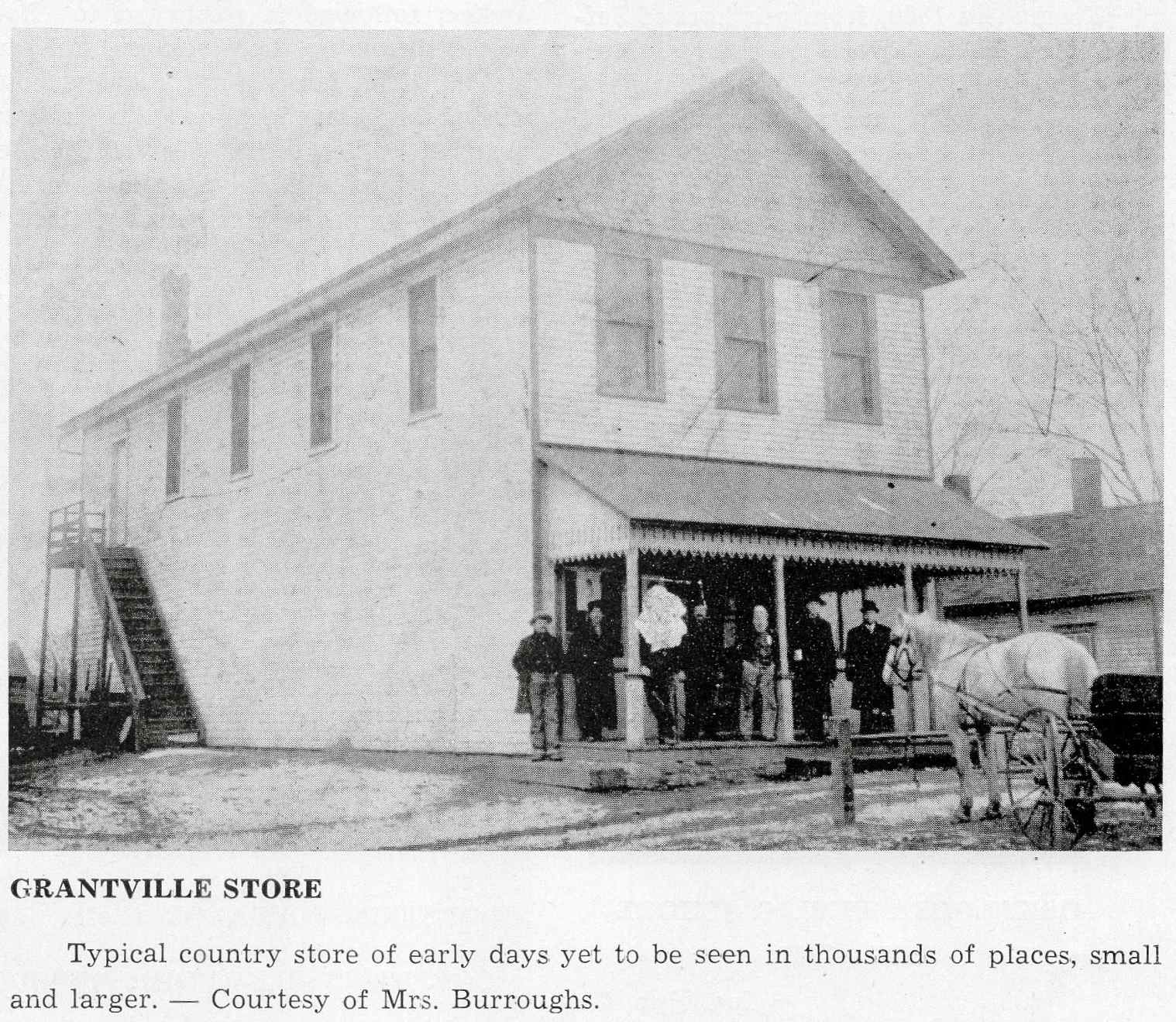
Founder of Grantville Dies

From the Perry Mirror, Sept. 8, 1921

Donated Townsite of Grantville and Laid it out.

A.J. [Andrew Jackson] Kleinhans, 90, one of the pioneer farmers and stockmen of Jefferson county, died at his home in Grantville, Tuesday. Death followed a stroke of paralysis which he suffered last Saturday. Mr. Kleinhans was born in Belvidere, N.J., April 25, 1831, and was educated in Belvidere college. He went to California during the gold rush of 1849, coming back to Kansas in 1856. He purchased the farm on which the family now lives, in 1857. The townsite of Grantville was laid out by Mr. Kleinhans and donated to the town's company. The Kleinhans home is one of the finest in Jefferson county.


Mr. Kleinhans was one of the original incorporators of the Bank of Topeka and was one of the close friends of the late John R. Mulvane. In 1856, Mr. Kleinhans married Mary J. Coffman, whose father was also a pioneer resident of Jefferson county. Mrs. Kleinhans survives her husband.


Two sons and two daughters also survive. Charles H. lives at Grantville, John A. resides at 827 Quincy Street. Mrs. W.T. [Della] Crosby, a daughter, is in California with Mr. Crosby, and is now on her way back to Topeka. Mrs. Mattie A. Ingram, another daughter, lives in Calcutta, India, with her son, Everett Ingram, representative of one of the largest rubber concerns in the United States.


Mrs. Crosby will arrive in Topeka in time for the funeral which will be held at Grantville, Thursday. The funeral will be private. — Topeka Daily Capital


This story appeared in “Yesteryears” in April 2003.


From the Topeka State Journal, Jan. 4, 1930

Mrs. Mary J. Kleinhans, 87, widow of the late A. Jackson Kleinhans, for seventy-one years a resident of Grantville, died this morning at the family homestead. 


During the first term of President U. S. Grant, Mr. Kleinhans founded the town. The neighbors favored naming it Kleinville, but he was a modest man and insisted that it should be named in honor of the President. He donated the land for the Methodist Church, of which his wife was a member, the district school and the railroad station. Mr. Kleinhans died in 1923 at the age of 90. 


From The First Hundred Years of Jefferson County, Kansas:

Kaw Township

Originally a part of Kentucky township. It was organized in 1858. Settlers of 1854 were Jefferson Riddle, J.T. Wilson, K. Kukendall and R.P. Beeler. A town company was formed in 1857 and a town site of 320 acres was laid off and named Kaw City. A postoffice was established in 1858, on the east side of Big Muddy Creek. When the Kansas Pacific came through the township in 1865 a station was built on the farm of D.W. Kleinhans and called Kaw station. The Kaw City postoffice was moved to the new location, Mr. Kleinhans laid off a town around it, this was the original town of Grantville.


Friday, November 27, 2020

School Teacher Duties Questioned

  The Winchester Star, Nov. 16, 1945

A puzzling problem has been tossed into the lap of J.D. Everett, county superintendent. The question asked him by one of the school districts of the county is thus: “Is it the duty of the teacher or the janitor to ring the school bell?” It seems the two are loggerheads over which one should perform this task, and Mr. Everett is now studying the situation, preparatory to making his decision.


The Winchester Star, Nov. 30, 1945

J.D. Everett, county superintendent, has announced a solution of the bell ringing problem, tossed in his lap a few days earlier by a school district in the eastern part of the county. The problem arose when the teacher and janitor each refused to ring the bell, stating the job should be done by the other. Everett met with the school board, and after hearing, it was announced that the janitor hereafter would ring the bell. The decision was that the ringing chore is not a part of the teacher’s duties.


This story appeared in “Yesteryears” in October 2014.

Saturday, November 21, 2020

Ozawkie Postoffice Robbed

  From the Perry Mirror, February 24, 1910

 The Ozawkie postoffice was robbed about 1 o’clock Sunday morning and about fifty dollars in cash and twenty-five dollars in money orders were taken from the safe. The thieves used dynamite in wrecking the safe and the people of the town heard two distinct reports. Nobody saw the thieves, although the dynamiting of the safe woke almost everybody in town. 


"West Side, Ozawkie, Kan., 1907"
from Ozawkie on the Delaware

The county authorities at Topeka believe that the men who robbed the postoffice at Ozawkie passed through, or are still in Topeka. A buggy occupied by two men believed to be the parties who wrecked the postoffice at Ozawkie, passed through Meriden at 3 o’clock Sunday morning just two hours after the robbery occurred and at 4:25 the same party entered North Topeka. A search of all the livery barns in Topeka revealed nothing and it is evident that the party did stop there.


This story appeared in “Yesteryears” in April 2003. 


Other papers included more details: 


The Oskaloosa Times,
Feb. 24, 1910
From the Valley Falls New Era, February 24, 1910


Saturday night the Ozawkie postoffice, location in the Ford Quiett store, was entered and robbed, more than $200 being taken from the postoffice safe.


It is supposed that two men were implicated in the robbery, which occurred about one o’clock. Fred Littlejohn and son were across the street in the Frost residence and stated early Sunday morning that they had noticed the men in the building and had heard the explosion, but didn’t notify any one of the facts because they “didn’t want to get mixed up in the affair.”


The robbery was discovered by people returning home from a country dance. “Shorty” Clark noticed the door was open and tried to close it, but discovered it was out of plumb. He struck a match and noticed the damage done inside and the safe, which had been blown open. He notified others and the sheriff was notified.


The men were traced west of Meriden, and later to Topeka. U.S. postoffice inspectors are working on the case.


Thursday, November 12, 2020

Dunavant Depot Sold

  The Oskaloosa Independent, March 5, 1926

Dunavant, Kansas
The "irony of fate" is seen by some in the sale of the Kansas City — Northwestern railway depot at Dunavant, Jefferson County, which soon will be turned into a filling station to supply gasoline for the motor car which doomed the railroad to the junk heap. The sale of the depot, announced this morning by W.W. Hooper, is the first of any property belonging to the defunct company outside of Wyandotte County. Judge McCabe Moore, Kansas City, Kan., has sold some of the buildings in Wyandotte County. Mr. Hooper sold the Dunavant depot to E.L. Burdick of Nortonville. It is Mr. Hooper's understanding that Burdick will move the depot to Nortonville and put it into use as a filling station. Dunavant and Nortonville are connected by a hard surfaced road and it is believed the building can be moved by truck with but little trouble.


Mr. Hooper will leave tomorrow morning for a trip over the road. In each county through which the road passes Mr. Hooper will stop at the county seat and engage a local attorney to take charge of the disposal of the right of way. At Oskaloosa Mr. Hooper selected Horace T. Phinney. Other selections have not been made. However, wherever the company had a local attorney, that attorney will be given the preference, Mr. Hooper said. There is a blanket mortgage over the entire right of way and negotiations will be entered into with landowners to clear up this mortgage. Where the company holds fee simple title, the land will be conveyed by deed. Mr. Hooper expects to be gone several days. He believes it will require about eight months to wind up the affairs of the company. The rails are to be sold as junk. (Leavenworth Times)


An advertisement from the
Valley Falls New Era
, Aug. 3, 1916


 This story appeared in “Yesteryears” in April 2015.

Sunday, November 8, 2020

50,000 Old Soldiers (1890 Reunion)

 From the Meriden Weekly Tribune, November 27, 1890

The Tenth Annual Reunion of the Veterans at Topeka next month will be the largest and most important gathering of old soldiers ever assembled in Kansas. Judging from present indications, the committee estimates that fully 50,000 old Soldiers and Sailors will attend the Re-union.


Several hundred large tents are being put up on the State Fair Grounds, and the local committee are making preparations to receive and entertain their visitors in a manner every way worthy of the generous hospitality of our Kansas people. The camp will be laid out by States, and one day will be given to the formation of State Association and to Regimental Re-unions.


The President of the United States, Gen. Harrison, and other eminent soldiers and statesmen will be present and help entertain “the Boys in Blue.”


Col. Forsythe of the U.S. Army, with several troops of cavalry, artillery and infantry will participate in an exciting sham battle, bombarding and blowing up Fort Fisher at night.


The jollifications will commence on October 7, and continue four days and nights – mostly nights – when fireworks, sham battles, campfire stories, and foraging will be the order of exercises.

Gen. Alex. McCook will address the Re-union of the Army of the Cumberland.

  • An interesting programme every day with cavalry and artillery drills, dress parades, &c.
  • The Veterans wife and family will have special accommodations provided.
  • Tents and Barracks, Wood, Straw, Water, Lights, etc., free including the freedom of the city.
  • Half fare on all Railroads.

 If you have any doubts as to the foraging, address Maj. T.J. Anderson, President of the Committee of Forty-three, Topeka, Kansas, for further information.


This story appeared in “Yesteryears” in April 2012.

Monday, November 2, 2020

Automobile Ride, 1908

The Meriden Ledger, May 7, 1908 

1908 Rambler Touring Car
Dr. Marks, with three ladies and a gentleman, rode out over our roads one evening last week just at dark in his big Rambler automobile, it all lighted up to perfection. Telephone messages ran ahead of them announcing their coming and the farmers were out looking at a nice scene. Now if our horses will only behave themselves, let them speed away. 

This story appeared in “Yesteryears” in April 2013.

Tuesday, October 27, 2020

Atchison, Oskaloosa & Lawrence Railroad

From the Atchison Daily Patriot, June 3, 1869 

An election to take place on the 2d day of August, to determine the question of Atchison county subscribing one hundred and fifty thousand dollars to the capital stock of the above named railroad; in fact, the question is, shall this road be built — for if Atchison county does not do its part, and do it now, this road never will be built. Leavenworth, foreseeing what our system of railroads will accomplish, if successfully carried out, is bringing to bear every influence in her power to delay, and if possible to defeat, the building of this road, and the Atchison, Topeka and Santa Fe railroad. 

As is known, Jefferson county has voted one hundred and fifty thousand dollars to each of these roads, and Leavenworth has succeeded in getting up litigation over the Jefferson county bonds, hoping thereby to delay, and finally defeat, both enterprises. 

Our Leavenworth neighbors are sore pressed, and men in such straights will make desperate efforts and take any risks.

The argument they use in Jefferson county, and particularly at Oskaloosa, is, that if the bonds to both roads can be defeated, they can change the terminus of the Atchison, Topeka and Santa Fe road from Atchison to Leavenworth, and build by Oskaloosa, and thereby save to the county one hundred and fifty thousand dollars — as they will only ask that sum — and defeat the Atchison, Topeka and Santa Fe road, and kill off Grasshopper Falls as a rival of Oskaloosa. And, in order to make the dose palatable, they assert that Atchison never intended to help build the Atchison, Oskaloosa and Lawrence road, but only got that up as a trick to get bonds voted for the Atchison, Topeka and Santa Fe road. By these means, they induced some of the people in the vicinity of Oskaloosa to join them in an effort to defeat the bonds to both roads. 

But since our county board has ordered an election in our county to aid this road the people of Jefferson county begin to see the trick on the other side, and the opposition to the bonds in Jefferson is fast giving way, and if Atchison county votes the bonds, all will be well, and both roads will go on in spite of Leavenworth. 

The Lawrence people have also been talked to by Leavenworth, and they are waiting to see what Atchison does. They promise to do as much, or more, than Atchison; and if they do the Atchison, Oskaloosa and Lawrence road can be put under contract at once, and built within the next year. 

 Shall we vote the bonds? By the terms of the subscription we issue no bonds unless the road is completed — and in my judgment we ought to vote the bonds. 

With the bonds, I believe the road can and will be speedily built, and will pay Atchison better than any of our roads. It will do us more good, because it does Leavenworth more harm, and their people see it, and hence their efforts to defeat it. 

More hereafter. 

        T. 

This story appeared in “Yesteryears” in April 1988.

Sunday, August 23, 2020

Talking Picture in Oskaloosa Theater

The Oskaloosa Independent, March, 21, 1930 

W. A. Payne has equipment ready for DeLuxe. 

Hopes To Have Installation Completed by Saturday, the 29th, But Has Considerable Changing To Do. 

Oskaloosa will have talking pictures by Saturday, the 29th, provided installation troubles do not cause delay according to W.A. Payne, DeLuxe Theater owner. Mr. Payne has his “talking” equipment purchased and in his theater, ready to be put in. 

Considerable changes must be made, however, in the building, before successful operation. A sound-proof booth for the machines must be built and the walls and stage lined. The talking-picture machines are on the vitaphone principle. Disks which correspond exactly with the film rotate, like a phonograph; and a fader cuts one machine in and the other out, as the film goes from one picture machine to the other. An electric pick-up sends the sound from the disks through an amplifier into a speaker which throws the sound into the theater. 

There is only one way to get good results in talking pictures, Manager Payne says, and that is to try it out and correct the defects. Until the machines work to the satisfaction he will not start the talkies, but hopes to have things in readiness by next Saturday night. 

NOTE: Apparently he did not get satisfactory progress as it appears the talkies opened in Oskaloosa on April 4, 1930, with “The Phantom in the House.” That was followed on April 11 with “The Rampant Age.” 

This story appeared in “Yesteryears” in April 2015.

Saturday, August 1, 2020

Special Notice, from the Barbers

The Valley Falls Register, March 26, 1886


We the undersigned Barbers doing business in the city of Valley Falls, Kansas, hereby give notice and mutually agree that on and after the first day of April 1886, we shall charge the following new prices for work:
  • Shaving 10 cents.
  • Hair cutting 25 cents.
  • Shampoo 25 cents.
  • Sea Foam 10 cents.
  • Mustache dyeing 25 cents.
  • Dressing hair 5 cents. 
No more tickets, will be issued nor, quarterly or yearly contracts made.

Signed:
McGinnis & Delorm,
Paul Krumery,
Geo. Lewis,
March 19, 1886


This story appeared in “Yesteryears” in April 2012.


Saturday, July 25, 2020

The Threshing Crew, 1881


By Clara Agnes Luse Koenig, from the Luse Family History

The following is an excerpt from the Luse Family History and journal kept by Clara Agnes Luse Koenig, daughter of Allen Timothy Luse and Maria Allen Luse. Allen and Maria Luse came to Kansas in 1859, settling near Mound City, Linn County. They then moved several times in and around Jefferson County.They moved to a farm near Winchester in 1863, then to Nortonville in 1891. This was submitted by Linda Lloyd Kaiser, granddaughter of Clara Luse Koenig, Great Bend.

1881: This is the year my father and brother Charlie bought a threshing outfit which consisted of a separator and a ten horse power unit. This meant that the ten horses turned the power unit that turned the separator that threshed the grain. The power unit consisted of a circular middle section of machinery, cog wheels, etc., from which extended five removable levers to which the five teams were hitched. A platform was placed over the center machinery on which the driver stood with his long whip keeping the teams moving steadily around in a circle. A long rod was attached to this cogwheel machinery, near the ground, and was extended to other cogwheels on the separator. This was called the tumbling rod and was in sections. Driving the teams was a dizzy job as the platform on which the driver stood kept turning as the machinery turned and after hours of steady work relief was necessary.

Drawing of a horse-powered thresher from a French dictionary
(published in 1881)
from WikiMedia Commons.
Bundle wagons brought the grain to the separator and tossed them onto the band shelf at the front end where a man with a band cutter, a large sharp knife, cut the bands on the bundles and shoved them over to the feeder. The man feeding the machine had to pull the bundle apart and feed it evenly into the feed cylinder for if too large a bunch was fed in, it might clog the cylinder and cause delay or even a break in the machinery. As the grain passed through the machine, the kernels were threshed out, the straw was carried on through and into the straw carrier at the back end. This carrier was an endless belt of canvas the full width of the machine, operated by a belt that moved it up and out. The grain flowed into a covered box and downspout on the side of the separator into receptacles. Father spread a canvas on the ground and then set his half-bushel measure under the spout to catch the grain. Father kept tally of the number of measures of grain on a tally sheet. When they threshed at home, I stood near Father and held a grain sack open so he could pour the grain in. All our grain was sacked, as grain-tight wagons were few and we had none. The straw carrier was stationary so there had to be pitchers there to pitch the straw away and build a stack. It was a very dusty job with chaff getting all through their clothes and the men all fought shy of being on the straw stack. It usually took three to handle it. It was a slow process all the way through and took thirty or more men to do the work. Father, Charlie, Will, Frank (brothers of Clara) and Jim McClure, a neighbor, was the crew that went along with the machine. Frank was band-cutter, Will was feeder, Father tallied and Jim was driver on the horsepower. Charlie was relief man to keep the machinery running or on errands.

There were not many threshing outfits around as they were quite expensive so they traveled all around over the country from early July until October. Separators were huge clumsy affairs and required two teams to move them, especially over rough roads that were common at that time. Moving from one job to another was quite a process, special care being taken in crossing bridges or fording small creeks. They had many funny experiences as they traveled from place to place threshing. The farmers’ wives had varied reputations as to feeding threshers and it sometimes took considerable ingenuity to make a job terminate or last long enough to get to a certain place for the next meal. The crew stayed with the machine all week, coming home for Sunday if there wasn’t repairs to make on the rig. 

The Rumely company was known for steam-powered threshers.
Photo from Jefferson County Genealogical Society Library.
One family was noted for being slack and dirty about the house, so they had a hard time getting threshers to come there. Finally Father couldn’t get out of it any longer and had to go there. They had quite a lot of grain and they had to stay for two nights. The boys insisted on sleeping out on the straw stack, but Father was the big boss and must have the courtesy of sleeping in the house. Well about ten minutes after he went to bed he found he was not alone, in fact a whole regiment of company had moved in to dine on him. He fought and killed relentlessly for a couple of hours then gave up, put on his clothes, stole out of the house and joined the boys on the straw stack. There was considerable activity around the house the next day and that night when Father was refusing to sleep indoors, they insisted strongly that he sleep inside so he finally went in to bed. He found the room had been thoroughly cleaned and not a bed bug showed up that night. It rained that night and the boys had to forsake the straw stack and sleep under the separator.

Horses thresh wheat in Denton, North Carolina.
The wife of the wealthiest farmer in the community was the stingiest provider and they hated to eat there. Threshing is hard work and the men always have enormous appetites, but one time she gave them mush and milk for dinner. Another time when they were eating, she came in with a pie and said, “Pie, pie, anyone want pie, if you don’t, I won’t cut it,” and never giving anyone a chance to say anything took it back to the kitchen.

It was always hot at threshing time and with a wood stove going in the kitchen they often set the table out in the yard where there might be some breeze. Then it took a couple of little girls with peach tree switches to shoo the flies off of the table during dinner. It took a mountain of food to appease their hunger and pies were stacked three deep on a plate and cut in quarters for a serving.


The McLouth Threshing Bee website has event information and updates.

This article appeared in “Yesteryears” in October 1985.

Sunday, July 19, 2020

Part 2: Leavenworth, Topeka and Southwestern Railroad


Originally written by John Bower, as a two-part article on the L.T. & SW Railroad, this article was published in the Jefferson County Historical Society Newsletters of August and September 1982.
-       - - - - - -
Principal source for the early history is The Oskaloosa Independent, published for 100 years in Oskaloosa by the Roberts family (to be cited as IND, or simply by the date of issue where the source is indicated by the text). [John Wesley Roberts was the Independent editor at the time of the L.T. & SW Railroad bond issues and construction. His son F.H. Roberts took over as editor in July 1882.]

PART 2: HALF A CENTURY OF SERVICE AND STRUGGLE, 1882 -1931

Map from "People's Railroad: The Leavenworth and Topeka, 1879-1931"
by I.E. Quastler
Ninth Draft, October 18, 2000
Manuscript held in the Historical Research Division of the Kansas Historical Society
It was probably appropriate that the first train from Leavenworth to Topeka over the new line was only a locomotive and one car. (The Oskaloosa Independent, “IND” Oct. 14, 1882) Thirty-nine years later, writing for The Topeka Daily Capital (TDC Sep. 25, 1921), F.H. Roberts related how the independent line had been “taken over” by the Santa Fe and Union Pacific companies, which then “owned” the territory invaded by the little stranger.

“As the years went by, with one engine and three or four freight cars and an accommodation compartment coach dragging their slow way one round trip per day over the line, the annual reports showed ...deficits ...running from $20,000 to $40,000 a year.” After being turned over by the construction company in May 1883, the road was operated by the Santa Fe until January 1889, then by the Union Pacific until March 1894. It was in receivership until reorganized as the Leavenworth and Topeka Railroad (L&T) January 31, 1900. Stock in the new company, as before, was held by the UP and the Santa Fe. (ICC Docket 601)

Operations continued as before. The L&T spent a dollar and thirty cents for every dollar taken in. Losses were absorbed by the parent companies. (ICC Docket 601) Though the charter called for separate freight and passenger service, they ran one mixed train per day. (Kansas City Star, Aug. 1, 1916)

According to the Star, matters came to a head in March when the Kansas Public Utilities Commission (PUC) ordered the L&T into receivership, protesting they were already losing $25,000 a year. U.S. District Judge John Pollock tossed the ball back to the PUC by asking it to select the receiver. He was not to be paid a large management fee, and he must pay expenses from revenues.

W.A. Austin, retired businessman, formerly with the Burlington Railroad, was appointed receiver at $100 a month. He immediately put on a passenger train, giving the area better service than it had had in years. An attempt by the Santa Fe to prevent use of its tracks into Topeka by the new passenger train was blocked by Judge Pollock.

The Star painted a rosy picture. Austin was making improvements on the track and giving better service, while making a little money every month. The Star had a simple explanation: The U.P. and the Santa Fe had been “milking” the orphan road.

Though it was the shortest route between Topeka and Leavenworth, not one through ticket had been sold over the L&T in five years. No joint rate existed with any other road; an L&T agent could not sell a ticket to any place not on the line. Now, Austin was even talking of putting on an overnight sleeping car for Chicago and the east.

Another midsummer night’s dream appeared in 1916. According to The Topeka State Journal (TSJ) on July 29, 1916, the Willard E. Winner interests of Kansas City had purchased the L&T and would convert it to electric inter-urban service. Local freight and produce would be handled, but the big thing would be hourly trolley car service between Topeka and Kansas City, seven days a week.

Track would be laid on the 34-year-old unused grade between Meriden and Topeka. Cars would enter Topeka near Garfield Park and run up Kansas Avenue on the street car tracks.

Recreational use was to be featured. “Some of the most attractive fishing, outing and camping resorts and locations in the midwest are on the line between this city and Leavenworth,” the Journal enthused, 40 years before Lake Perry was formed. There was talk of a branch line from Oskaloosa through Valley Falls to Holton.

While this proved to be only a pipe dream, it is interesting to ponder the effect of hourly inter-urban service to Kansas City and Topeka on Oskaloosa and other Jefferson County towns in that still largely horse and buggy era.

Things returned to normal early in 1917 when the passenger train was taken off, by order of Judge Pollock at the request of receiver Austin, and to the embarrassment of Governor Arthur Capper. (TSJ Feb. 6, 1917) According to The Journal, The Topeka Capital, Capper’s newspaper had been touting the success of the L&T under Austin in support of the governor’s public utility bill in the legislature.

Needling Governor Capper for the report, the Capital printed the notarized document bearing Austin’s signature from official court records, and, gleefully added Morgan Albaugh, clerk of the United States court, expressed regret that Governor Capper had not proven himself big enough and fair enough to specifically correct the misstatement in Monday’s Capital editorial.”

Pollock gave the Union Pacific and the Santa Fe ten days to end the receivership and operate the road or to foreclose the mortgage and put the line up for sale. (TDC Feb. 11, 1917) He revived the hope of making it an electric line.

It took all summer to find a buyer. In September, the L&T was sold to a group headed by Chicago capitalist F.L. Wells. (TSJ Sep. 17, 1917) The new owners talked about improved service, including use of motor coaches for carrying passengers.

Their real intention, however, appears to have been much simpler. Wartime demand for scrap iron had raised prices enough that the new owners could junk the line at a profit. Like the Rock Island 60 years later, the L&T was worth more for scrap than as an operating line.

Now the life of the L&T hung by a thread. By December, patrons along the line and businessmen from Leavenworth and Topeka were protesting an attempt to scrap the rails from Ozawkie to Meriden. (TDC Dec. 24, 1917) Citizens argued this was just the preliminary to junking the whole line. (TDC Dec. 31, 1917)


A.O. Kendall, cashier of the Ozawkie State Bank [original article refers to “A.O. Kandall,” other references say “Kendall”], in a letter to Congressman Daniel R. Anthony, said that sale of the L&T to private interests at a price less than its junk value was a move by the Santa Fe and Union Pacific to eliminate competition, while speculators made money junking the line. (TSJ Jan. 2, 1918) When Topeka wholesale business concerns tried to help the road by diverting eastern shipments over it, the letter related, the L&T bridge-men condemned the bridge over the Delaware at Ozawkie. An engineer for the Public Utilities Commission said it could be fixed for $600.

“Our conclusions are,” Kendall asserted, “that Mr. Wells bought this road with the object of junking it ... his operation has been with this object in view and managed so it would unprofitable.”

An attempt was made to use wartime control of the nation’s railroads to prevent scrapping the line. At a conference with the government railroad administration in Washington (TSJ Jan. 24, 1918), counsel for the Kansas PUC presented information to show that the L&T had been purposely operated at a loss for years to destroy it as a competitor. Congressman [Daniel Read] Anthony argued that congestion in the Kansas City terminal could be relieved by diverting traffic from the north to the southwest over the line, while junking it would leave several towns and grain elevators without service when grain was needed in the war effort.

The attempt to use federal war controls to save the L&T failed when the government decided not to take control of small railroad lines. (TDC, Feb. 2, 1918) Notices were sent to customers along the line that service would end on Wednesday, Feb. 6.

Trustees of townships which had voted bonds to build the line, and Topeka shippers, immediately lodged vigorous protests with the federal court against destruction of the road. A protest meeting was called at Oskaloosa Monday, Feb. 4.

At a hearing before Judge Pollock in Kansas City February 19, Wells claimed the railroad was losing $1,000 a month, while he could sell it as scrap for from$160,000 to $200,000. (TDC Feb. 20, 1918) Patrons of the line protested strongly.

After a long day, Pollock said he would sell it to the people along the line as an operating road for $80,000, less taxes due. He gave them thirty days to raise the money. This scaled-down price probably allowed Wells some profit.

F.H. Roberts, editor of The Oskaloosa Independent, served as chairman of the committee to raise the money. (TDC, May 11, 1918) Walter Johnson, managing editor of The Topeka Daily Capital, took a prominent part. (Chicago Tribune, Current Opinion, April 1919, Page 268) More than $100,000 was subscribed by some 800 farmers and businessmen along the line, in amounts $10 to $1,500. (TDC, April 4, 1918)

The Capital reporter painted with vivid strokes the scene in the “dingy” offices of the L&T as the committee made its offer to buy. Mingling with the farmers and merchants, “some of whom saw possible ruin staring them in the face in property was wrecked,” were “commercial vultures, or junk dealers, eager to hop upon the carrion… Little did they care…”

When some Topeka businessmen threatened to withdraw their support because Judge Pollock retained control of the road until the new owners proved they could run it, the Capital ran a blistering editorial (May 27), declaring, “Topeka can afford to put up $15,000 for this purpose if it never sees a cent of the money again. To refuse to do this is to give Topeka a black eye with the people of this territory from which this community will never recover…” If a tornado hit Jefferson County, they would be quick to give aid, he said, and loss of the railroad would be far worse.

“L&T RAILROAD IS PURCHASED BY PATRONS OF LINE” ran the headline in the May 11 Capital. The good guys in this “long and bitter fight” were the members of the citizens’ committee and Capital editor Johnson. The bad guys were capitalist Wells and his attorney, James W. Orr of Atchison, and “The State Journal, of Topeka, which misrepresented the activities of the committee at every turn, and did not hesitate to resort to plain and fancy lying in its effort to deprive the people of this needed railroad service and to deal Topeka a deadly blow in this rich territory…”

Said editor Johnson, “It has been a hard fight, but it has been demonstrated that a determined people and a just court can circumvent even the most wily lawyer and the most avaricious speculator if there is a will to do it.” Johnson believed that community ownership could solve the problems of many branch lines.

The new Leavenworth and Topeka Railroad Company was chartered May 16, 1918. Among the incorporators were Sam Hill, Ackerland; Walter Pennington and G.M. Casebier, McLouth; F.H. Roberts and Horace Phinney, Oskaloosa; and O.A. Kendall and Ira Puderbaugh, Ozawkie. (TSJ, May 16, 1918) J.E. Wadill, Kansas City lumberman, who had three yards along the line and was the largest stockholder, was elected president. (TDC, May 18)

The people had bought themselves a railroad. Now all they had to do was run it. If they failed, it would go back to Wells.

Service was restored once (TDC, June 8), but troubles were not over. Within a year, Topeka stockholders were asking townships served by the road to issue bonds to retire the capital stock and make needed improvements. (TDC, May 17, 1919) Valley Falls, which had daily train service, was reported ready to make a fight for the county seat. “At times Oskaloosa does not see a train for several days, said W.H. Stanley, editor of the Meriden Ledger,” the Capital reported.

High water damaged the bridges at Ozawkie in the spring of 1919. To repair the washouts and make improvements in equipment, the directors asked stockholders to raise a fund equal to about ten percent of the face value of their stock. (IND, April 4, 1919) Certificates would be issued to cover the additional contributions.


Soon after acquiring the L&T, directors had put on a gasoline powered motor car — a converted Reo automobile — for passenger service. The motor had had a number of accidents, all the way from derailment at crossings to knocking a farmer’s wagon off the track, but “it remained for a mangy old shepherd dog to put the gas wagon completely out of business.” (IND, May 16, 1919)

The dog had often run ahead of the car, barking furiously, while the motorman chased him. One day they caught him. The bus derailed and was demolished. One of the passengers, Lew Wiley of Oskaloosa, said the car ran on the ties several rods, then turned over three or four times as it fell down the embankment. Miraculously, [only] one of the eight people aboard was seriously injured.

It was some time before motor service was restored. People were complaining about lack of the service. A new motor was promised by September. (IND, June 13, 1919) While the service had been popular, our limited research did not confirm of a new motor until the summer of 1921.

A new motor coach was put in service in July. (TSJ, July 23, 1921) Housed at McLouth, it went to Meriden twice and to Leavenworth once every day, allowing Jefferson County passengers to spend several hours in either Topeka or Leavenworth and return home the same day.

The new service was an immediate success. (TDC, Sept. 27, 1921) Built to order by the White Motor Company of Kansas City, the new bus was longer and heavier than the old Reo. Seating about 25, it had carried as many as 64 persons. It cleared about $1,000 the first month.

Known affectionately as “The Galloping Goose,” it was a familiar sight and sound on the L&T during the twenties. I can still hear the hum of its wheels and the trill of its exhaust whistle, and remember the thrill of riding it to Leavenworth.

In July 1919, the directors proposed a bond issue to pay off the line’s debts and buy equipment, (IND, July 25, 1919) They had secured legislation setting up a benefit district four miles wide on each side of the line. (TDC, Sept. 27, 1921)

After employees struck the Kansas Northwestern Railroad, which also served McLouth and Oskaloosa (IND, Aug. 8, 1919), the Independent cited the uncertain future of the KCNW to encourage support of the railroad bonds. (Aug. 22, 1919)

The McLouth Times (IND Aug. 29, 1919), called attention to the bad fix the country and towns would have been in during the strike but for the “little old L&T.” The Jefferson County part of the district approved $50,000 for the railroad; Leavenworth County $25,000. (TFC, Sept. 27, 1921)

Officers and directors served without pay as a community service. Among those serving in 1921 were A.O. Kendall and Ira Puderbaugh, Ozawkie; A.H. Leech, Oskaloosa; E.D. Bradford, George Casebier and H.H. Kimmel, McLouth; and Sam Hill, Ackerland. F.H. Roberts was Assistant General Manager. (TDC Sept. 27, 1921)

By 1923, Roberts was managing the line himself. (TDC, Aug. 9, 1925) He had effected further economy by running the train on alternate days, substituting a second motor coach on days the train did not run. Train crewmen manned the extra motor. Deficiencies in operating revenue were made up by an annual tax levy on the benefit district. In 1925, the levy was two mills and raised about $14,000.

But times were changing. By 1919 the good roads movement was in full swing. The first federal aid paved road in the county, running from Nortonville to Williamstown, was approved in early summer. (IND July 4, 1919) (From Oskaloosa south the road is little changed today.) Development of highway transportation doomed shortline railroads.

The tax subsidy no longer seemed a good investment and was dropped in 1929. (TDC Apr. 21, 1931) As the Depression deepened, the directors gave up. The last train ran April 30, 1931.

Contract for scrapping the line went to Sonken Galamba of Kansas City at the depression price of $6,500. (TDC Apr. 22, 1931) We had a sawmill in those days, and made lumber of many of the timbers from L&T trestles. Some of it went into the large, metal covered barn which has been a landmark for half a century on the first hill north of McLouth.

Terminal tracks in Leavenworth belonging to the L&T had already been sold to the Burlington for $165,000 and the bonds paid off. (TDC Apr. 22, 1931) Some land would revert to the original landowners; some could be sold. With the debts paid, about $40,000 remained to be distributed to stockholders — about 25 percent of par value.

So ended half a century of struggle and service.


Crossing a rough terrain, and having to fight for business with two giant competitors who controlled it much of its life, there were few easy times. Indeed, “Old Jerky” was something of a joke as a railroad.

They tell of one conductor who signaled departures with “let ’er go, Newt — one load and two empties.” With little business and heavy grades, trains were seldom very long. Even so, they sometimes stalled. Dad told of waiting west of McLouth while they took half of the train to the siding at McIntosh and came back for the rest.

They used to say the train went so slow west of Oskaloosa that you could get off and pick blackberries along the track. Sometimes they broke down, or stopped while the crew went for a drink at a nearby farmhouse.

There were many cuts in the hills near McLouth. In winter they drifted full of snow, and the train got stuck. The heaviest snowfall I can remember came in 1926 — 26 inches in about 24 hours. Roads were blocked. School was out. The train was stuck two or three days about two miles east of McLouth.

My grandmother Kimmel was on that train. With snow already falling, the trainmen wanted her to stay in Leavenworth. But Grandma was the wife of a director. She had a pass. Dad had a sled and a big team of horses. They brought Grandma and the mail across the fields, cutting fences as they went.

Fifty years later, few remember the call of the whistle or the chirp of the “Galloping Goose.” Many of the newcomers who have flocked to Jefferson County do not know that trains once ran almost through Oskaloosa, though much of the grade is still visible if you look for it.

As I said, there were few easy times. But after making this study, I believe the effort to bring a railroad across the middle of Jefferson County was worthwhile and I take off my hat in admiration to the men who carried it out.

— John D. Bower

Editors’ notes: On April 10, 1931, The Oskaloosa Independent carried this article: “Jess Davies, manager of the L.&T. railroad, has posted notices in the depots and elsewhere, along the line notifying the public that operation of the road will case on April 30th. This gives the patronizing public twenty days in which to ship in or out the ‘heavy’ after which it will be up to the trucks.”

 Further Reading:
 “The People’s Railroad, The Leavenworth &Topeka, 1918-1931,” by I.E. Quastler, Kansas History magazine, Spring 2001. A copy is available at the JCGS Research Library or online.
Quastler also wrote a complete study of the railroad, “People’s Railroad: The Leavenworth & Topeka, 1879-1931.” The manuscript is in the Historical Research Division, Library and Archives, Kansas State Historical Society. A copy is available at the JCGS Research Library.

This article appeared in “Yesteryears” in April 2015.